
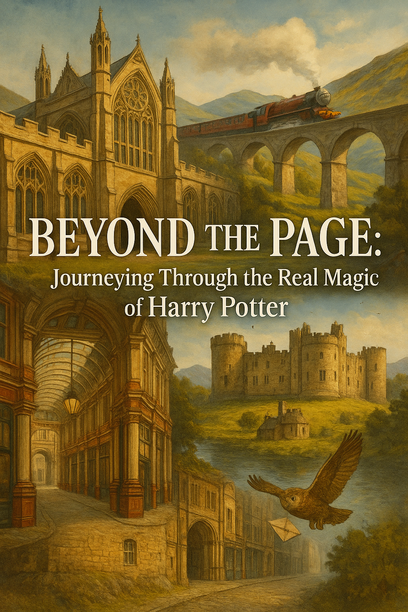
For a generation captivated by the enchanting world of Harry Potter, the line between fiction and reality often blurred. J.K. Rowling’s masterful storytelling transported us to a realm where owls delivered mail, portraits conversed, and magic hummed in every corner. Yet, the enduring power of this saga lies not just in its imaginative depth, but also in its surprising roots in our own world. From the cobbled alleys of London to the dramatic Scottish Highlands, countless real-life locations lent their ancient stones and mystical landscapes to create the iconic backdrops of Hogwarts, Diagon Alley, and beyond. This isn’t merely a collection of filming sites; it’s a pilgrimage for those who yearn to feel the echo of magic, to walk where Harry, Ron, and Hermione once “stood,” and to witness how ordinary places transformed into extraordinary settings that shaped cinematic history.
The very heart of the wizarding world, Hogwarts School of Witchcraft and Wizardry, found its cinematic soul in the venerable institutions and grand cathedrals across England. Oxford University, with its hallowed Christ Church Great Hall, famously inspired and depicted the grand dining hall where feasts and crucial announcements unfolded. Nearby, the Bodleian Library’s ancient shelves and quiet corridors became the Hogwarts Library and hospital wing, evoking a sense of scholastic wonder and hushed secrets. Further north, the formidable Alnwick Castle, home to the Duke of Northumberland, provided the sprawling exterior shots for Hogwarts in the early films, complete with its outer bailey where Madam Hooch taught broomstick flying and Quidditch hopefuls made their debut. Meanwhile, the stunning Gothic architecture of Gloucester Cathedral, with its intricate cloisters, was meticulously transformed into the very corridors where Harry encountered the petrified Mrs. Norris and where students scurried between classes, immersing viewers in the medieval grandeur of the magical school.
Venturing north into the breathtaking expanse of Scotland, one discovers the raw, untamed magic that infused the more dramatic and remote elements of the Harry Potter universe. The majestic Glenfinnan Viaduct, an architectural marvel curving gracefully through the Highlands, is perhaps the most iconic Scottish location, instantly recognizable as the path of the Hogwarts Express. Its towering arches against a backdrop of rolling hills and serene lochs evoke the thrilling journey to school. The dramatic landscapes of Glencoe provided the rugged setting for Hagrid’s Hut, portraying a secluded haven amidst wild beauty. The shimmering waters of Loch Shiel, framed by towering peaks, became the foreboding Black Lake, where Harry flew on Buckbeak and the Triwizard Tournament’s second task unfolded. These Scottish locales, with their inherent mystique and grandeur, perfectly captured the untamed spirit of the wizarding world, highlighting moments of both serene beauty and perilous adventure.
Beyond the rural enchantment, London itself, a city steeped in history and often veiled in a perpetual mist, played a pivotal role in grounding the wizarding world within a recognizable urban tapestry. Leadenhall Market’s Victorian architecture, with its ornate ceilings and narrow passages, served as the initial inspiration and setting for Diagon Alley and the exterior of the Leaky Cauldron, offering a glimpse into a hidden magical high street. Australia House, with its grand interiors, became the impenetrable Gringotts Wizarding Bank, a bastion of goblin-run financial secrets. Even the seemingly mundane King’s Cross Station transcended its everyday function to become the mythical gateway to Platform 9¾, a place of departure for young witches and wizards. These city locations demonstrate how magic could subtly intertwine with the mundane, revealing a hidden layer of wonder just beneath the surface of everyday life, and even inspiring J.K. Rowling’s writing journey, with The Elephant House in Edinburgh often cited as a significant creative space.
The journey through these real-world locations underscores a profound truth about the Harry Potter phenomenon: its magic is not entirely confined to the pages of a book or the frames of a film. It exists where imagination meets tangible history, where ancient stones whisper tales, and where the natural world provides a canvas for extraordinary adventures. Visiting these sites isn’t just about ticking off a list; it’s about feeling a tangible connection to a story that has resonated globally, an opportunity to step into the narrative and experience a flicker of the wonder that first captivated us. It reminds us that creativity often springs from the familiar, transforming it into something spectacular, and that the world around us, if we look closely enough, holds an endless capacity for enchantment. In a world craving connection and wonder, these physical touchstones allow us to keep the magic alive, long after the final page is turned.